The Early Universe
Although astronomers have uncovered many of the details revealing the
life cycles of individual stars, they still do not completely
understand how galaxies, like our Milky Way, begin and end their
lives.
The problem is that, although stars within the Milky Way may be seen in
a variety of evolutionary stages, few examples of young galaxies are
known, and their images come to us from the most distant edge of our
visible universe. That is,
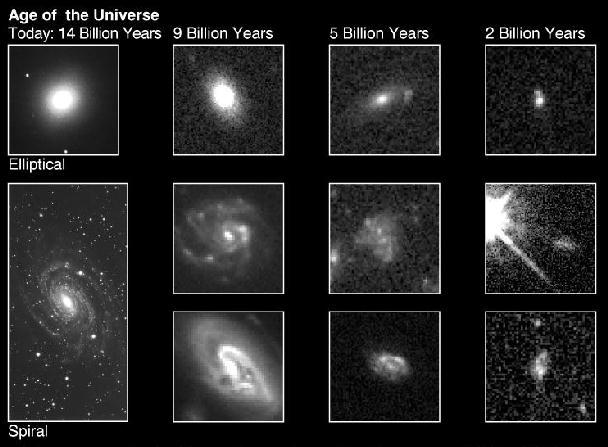
because of the finite speed of light, observing galaxies at large distances is
equivalent to
looking back in time to
the early history of the Universe,
as the image shown above indicates (click the image for an explanation).
For example, the image adjacent right
shows a cluster of galaxies at such a distance
that the light we see in the image was emitted when the Universe was about 2/3
of its present age.
(Click on the image for a
larger version with a description.)
At these vast distances,
it becomes increasingly difficult to determine what role environment
plays in the formation of a galaxy.
The following image shows galaxies from an even earlier time.
These galaxies
are about 12,000,000,000 light years away; thus, they represent the Universe
when it was only a few billion years old.
Click on the image for an explanation of this figure.
A discussion of the newest evidence for the Universe's early evolution may be
found in this
this NASA press release.